When it comes to measuring software development productivity, most teams still rely on LOC (Lines of Code) or Velocity (story points per sprint). These metrics are easy to track, but they often fail to capture the reality of developer effort. A three-line bug fix can take hours of debugging, while a 200-line code generation may take just a few seconds.
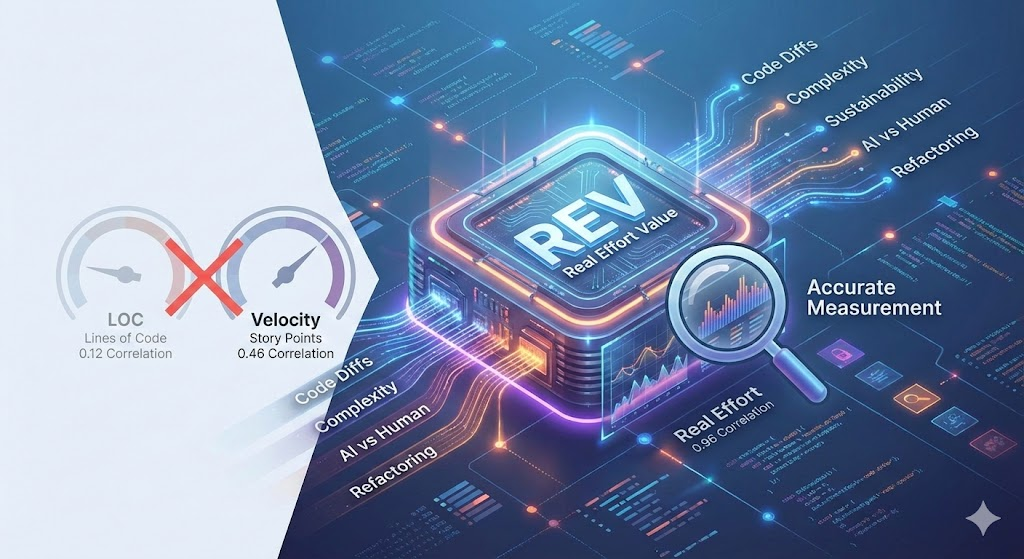
This gap is where REV (Real Effort Value) comes in. By analyzing code diffs, complexity, and sustainability signals, REV provides a far more accurate measurement of the true effort behind software development. In fact, internal validation shows that REV correlates with real developer effort at 0.96, making it one of the most reliable productivity metrics available today.
External research underscores the same shift. McKinsey’s 2023 Developer Velocity Index found that the highest-performing software organizations focus on product quality, sustainability, and business impact when measuring developer productivity—not raw output like commits or lines of code. GitMe’s REV operationalizes that mandate by quantifying the human effort hidden inside every change.
The Problem With LOC
Lines of Code have long been used as a proxy for productivity. The assumption is simple: more code equals more work. But reality is more nuanced:
- Boilerplate and auto-generated code can inflate LOC without adding real value.
- Complex refactoring or debugging tasks may result in few code changes but significant effort.
- Developers can be incentivized to write “more” instead of “better” code.
Correlation with real effort: ~0.12 (very weak)
The Limitations of Velocity
Velocity is usually measured in story points completed per sprint. It can help at the team level by showing whether capacity is improving, stable, or declining. However:
- Story point estimation is subjective and varies widely across teams.
- It reflects planned capacity, not actual effort spent.
- AI-assisted coding can reduce real work dramatically, while velocity remains unchanged.
Correlation with real effort: ~0.46 (moderate, but inconsistent)
Why REV is Different
Real Effort Value (REV) analyzes actual commit diffs, function complexity, refactoring versus feature additions, and even AI versus human contributions. Instead of guessing, it calculates effort in developer-minutes so that work is measured by what it takes—not just how it looks.
- A tiny but time-consuming bug fix is recognized as high effort.
- Large, trivial code generations don’t artificially inflate the score.
- AI-assisted commits are identified and separated from human effort.
- Long-term retention—whether code survives or is quickly reworked—is tracked.
Correlation with real effort: ~0.96 (very strong)
Comparison Table: LOC vs Velocity vs REV
| Metric | Correlation With Real Effort | Individual Accuracy | Team Trend Usefulness | AI Awareness | Sustainability Signal |
|---|---|---|---|---|---|
| LOC | ~0.12 | ❌ | ⚪️ Limited | ❌ | ❌ |
| Velocity | ~0.46 | ⚪️ Medium | ✅ Useful for teams | ❌ | ⚪️ Partial |
| REV | ~0.96 | ✅ Accurate | ✅ Strong | ✅ Yes | ✅ Strong |
Why This Matters for Engineering Leaders
Relying on LOC or Velocity often leads to misleading conclusions:
- Productive developers who focus on debugging, refactoring, or mentoring appear “less productive.”
- Teams using AI tools see inflated metrics that don’t reflect actual human effort.
- Leaders lack visibility into sustainability, burnout risk, and fairness in evaluations.
By adopting REV, leaders can
- Make fairer performance reviews.
- Detect burnout, overload, or underutilization.
- Track AI adoption versus human contribution.
- Build more sustainable software systems.
Key Takeaways
- LOC is misleading: it measures volume, not value.
- Velocity is partial: it is good for team trend tracking, but not individual effort.
- REV is reliable: with a 0.96 correlation to real effort, REV is the gold standard for modern developer productivity metrics.
If you want to move beyond vanity metrics and truly understand how your teams work, REV should be your north star.